Monday, April 1, 2013

coLABoratory: Lab 5 - Dan Visconti: Before the Lab


Feathers by Simon Tarr
It's taken a lot of composing/thinking/video editing/soldering/rewiring, but Simon and I are just about ready for Zankel this week! It’s such a treat to work on such a wild piece, one that we never would have been able to bring to life under the constraints of a typical orchestra schedule—but at the same time, all those possibilities create *lots* of things that can go wrong, and plenty of brilliant ideas crash and burn for want of an adapter plug. So we’re checking our I’s and crossing our t’s so that we can hopefully spend all of the time in rehearsal experimenting with cool sounds rather than trying to get X device to power on!

These ciruit-bent instruments are a real kick in part because of their utter unpredictability, but that same quality flies in the face of orchestra standards. For the next workshop, we need to be conscious of the inevitable challenges this will create as well as bringing out the happy accidents that will make the piece sound very different than a traditional, rigidly-controlled composition.

Dan Visconti
Our first priority of this last workshop is to verify that our setup works, after which time Simon will continue to focus on the video and make sure that it is getting enough audio input to make for enough motion (his video is reacting to audio input). The musical side of Glitchscape is not difficult, but as a large amount of the piece involves reacting and improvisatory elements it will require a slow “working through” every couple bars. It is important to work through the piece slowly as much of the interest will come from how we work out different events, so a slow trip through the entire piece is a must. After this has been worked out, we can focus on running the piece continuously.  

Friday, March 29, 2013

coLABoratory: Playing It UNsafe - Troy Herion: New York City Symphony Trailer


Check out the trailer for Troy Herion's newest visual composition, New York: A City Symphony, premiering next Friday at Carnegie Hall as part of the coLABoratory: Playing It UNsafe project.

Wednesday, March 27, 2013

coLABoratory: Lab 5 - Ray Lustig: Before the Lab


Ray Lustig

The latest of the workshops for Latency Canons was the first time I brought musical material that I knew would actually be going into the piece.  For the previous two workshops, I'd come with only fragments of music for testing out the dynamics of playing with delay under various scenarios (a conductor in New York conducting players in England, vice versa, no one conducting and the players just following each other by sound, or by sight only, etc. etc.).  And I actually ended up using none of that early fragmentary material in the final score.

But those early workshops were essential in helping me to figure out what kinds of material would work well, for showing me what scenarios of the imitative setup were likely to yield interesting results (or even be practically possible), and helping me get to the heart of what it was I wanted to do with this idea.

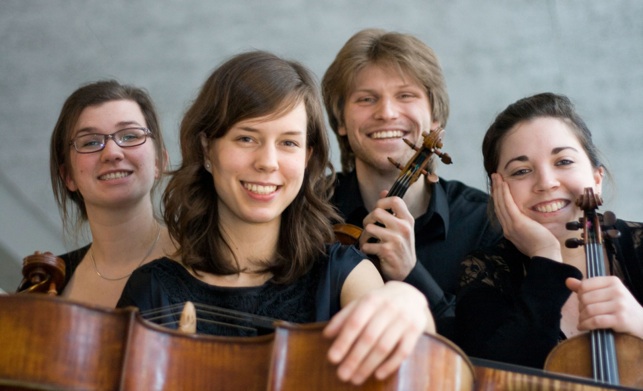
Gildas Quartet
Latency Canons is in some ways a concerto for string quartet, but the onstage string quartet is replicated in three other places (the furthest of which is the Gildas Quartet in Manchester England) that will all be in communication via GoogleHangouts.  The latency (delay) of the internet connection will hopefully allow the remote quartets to create a halo of resonance and reverberation around the onstage players' music.  This unstable and multipart echo made me think of a ritualistic recitation, as congregants chanting in a strange cathedral that wraps around the world all the way to Manchester England.

Dan Lame
The piece opens with only the onstage quartet playing.  Then the offstage quartets join in imitation.  The orchestra joins with its own imitations, and the piece becomes a conversation between the orchestra and the "canonists" of the four quartets.  Eventually conductor George Manahan passes the baton to conductor Dane Lam on the other side of the Atlantic.
 
The piece ends with the onstage players gradually dropping away, until only the offstage players are left playing.  The music that started on Zankel Hall's stage has drifted out into the world.

Thursday, March 14, 2013

coLABoratory: Lab 4 - Judith Sainte Croix: After the Lab


Judith Sainte Croix
At the 4th workshop of Vision V the entire Sonora Trio was present, Oren Fader on electric guitar, Andrew Bolotowsky on Native American Flute and composer Judith Sainte Croix on 88-key synthesizer.

The orchestra played with live synthesizer realizing the soundscapes we have been creating over the workshops.

Judith Sainte Croix
One of the experiments for this workshop was to try out the audience participation aspect of the piece. A group of students from Frank Sinatra High School in Queens was present and helped out with this. One of the issues being tested was the ease of teaching this part to the audience before a performance. I taught them their part in under 2 min. The conductor rehearsed them for less then a minute and they performed with the orchestra following their cues.

We tried running the digital images on the three large sections of the piece and decided to create more images - 10 in all - one for each of the subsections:

I.  Toward Liberation - Reaching, Extreme Mystery, Essence, Soarings;

II.  SunShadow - Wind Opens the Trees, Thunderbirds, Portal of Roots & Joy  

III.  Inner Space - Lucid, Breezes, Diamonds in the Grass

Each of the subsections will divulge the experience of the contemporary individual; seeking to capture an animating life force. The orchestral music forms alliances within and across instrumental family groups articulating the behavior of the fabric of humanity as the composition unrolls its aural story. 

coLABoratory: Lab 3 - Judith Sainte Croix: After the Lab


George Manahan & Judith Sainte Croix
At the second reading of Vision V we added the electric guitar, played by Oren Fader. In the sonic drama of the piece this sound represents a contemporary “everyperson” ranging from mild distortion in the lead guitar effect, moments of shimmering introspection in the planger effect and insight expressed by harmonics with echo, delay and reverb.

Andrew Bolotowsky  played the Native American Abenaki flute, the sound of which suggests something in the inner life. 

Andrew Bolotowsky
The orchestra worked with synthesizer sounds and poetic images of light creating sonic images which will be integrated into the score for the next reading. 

We tried running our first set of digital images as the orchestra read through the piece. We are developing digital images for each of the sections. 

I. Toward Liberation 
II. SunShadow -. Inner Space

Friday, March 8, 2013

coLABoratory: Lab 2 - Dan Visconti Explains His Inspiration


ACO’s “Playing it Unsafe” initiative is just what’s most needed at a time when everything about America’s major orchestral organizations—from programming to performance practice—seems increasingly routine compared to the range of musical and visual possibilities available to composers working today.


Lowcountry from Simon Tarr on Vimeo.

This current project, Glitchscape, is a collaboration with experimental film artist Simon Tarr (check out his website Quark Nova Films here). Simon has previously produced a fantastic film to accompany my composition Low Country Haze, which premiered in Spring 2012 at South Carolina’s Indie Grits Film Festival—so it’s great to take our collaboration one step further by creating a piece that features live video that pulses and syncs to the music via audio input algorithms. 

George Manahan & Dan Visconti
In Glitchscape, we’re looking to contrast our previous exploration of the natural world by incorporating technology into the project—specifically, a bunch of offbeat noisemakers and electronic toys that have been circuit-bent in order to make all kinds glitched sounds. The theme of glitching as distortion within a system is one that I’m eager to explore, and it’s cool to be playing with (and often abusing past the point of sanity!) several toys from the early 1980s such as the Speak & Spell unit.

Technology has come so far that old technology must be one of the most dated things imaginable—a casualty of the speed at which we move today, something that has been replaced by something newer and shinier and more efficient. This project will be an exploration of the expressive power of obsolescence, and how old and broken things have a way of touching us by virtue of their imperfections.

ACO & George Manahan
This process of exploration is a time-consuming and labored one, and it’s easy to see why most major orchestras might shy away from the rehearsal commitment in exploring such strange and uncharted territory. That’s why Simon and I are so psyched to have this tremendous opportunity to try out our work at several stages of completion. For the workshop on December 11th, we’ll be syncing a mockup video to some sample music for the strings in order to determine which electronics setups are possible—a prerequisite to developing the larger composition and an exciting point for beginning our explorations.