Showing posts with label Michael Geller. Show all posts

Tuesday, August 14, 2012

Jazz Composers Orchestra Institute Day 5 - Michael Dessen

Jazz Composers Orchestra Institute - Day 5
by Michael Dessen
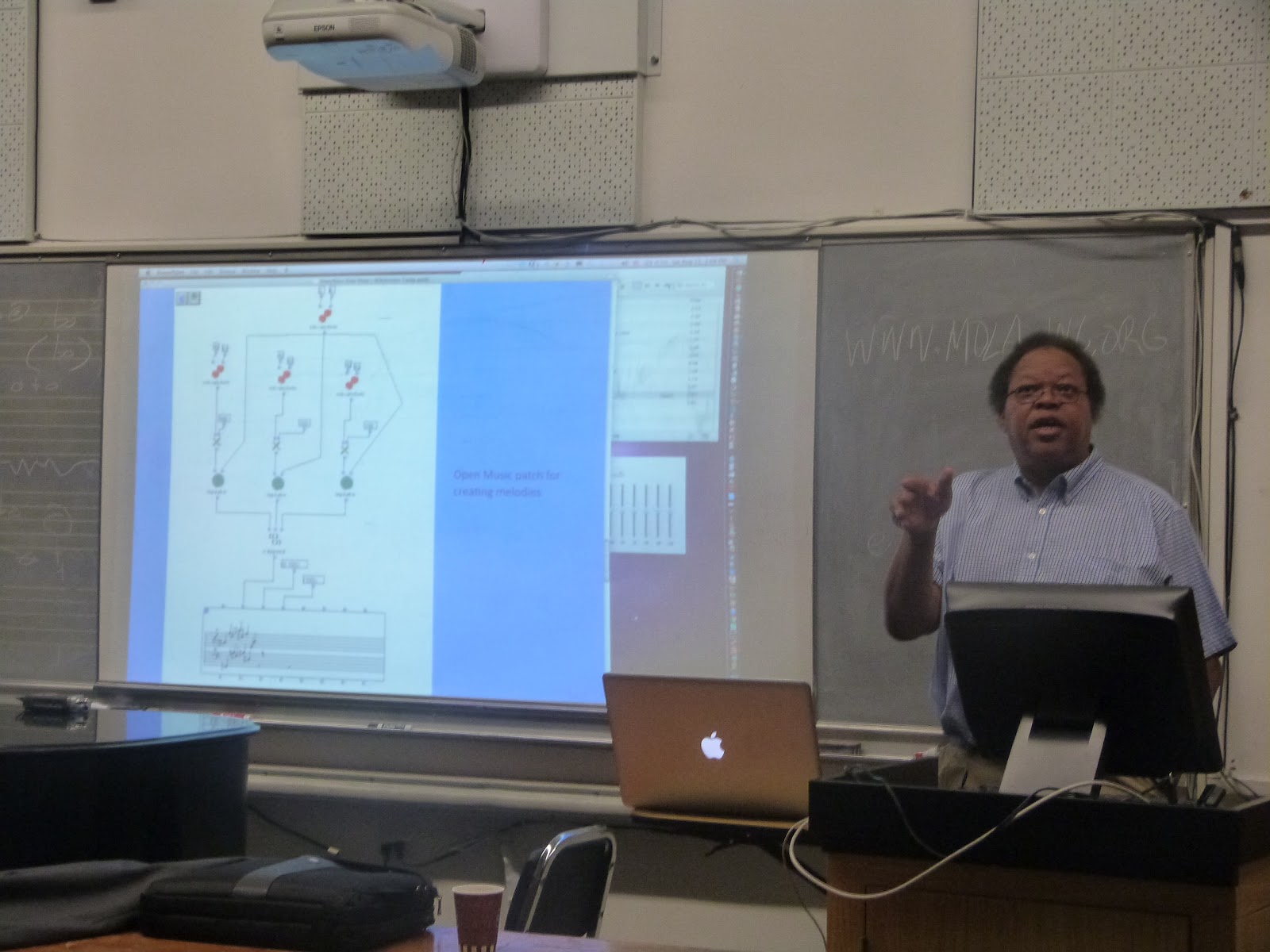
This morning George Lewis gave a class on "electronics and the orchestra." It was partly his own theorizing about our relationship to technology in broad terms, and partly a discussion of process-oriented techniques involving interactivity, spectral tools, and other topics far less familiar to JCOI participants than other technologies he didn't cover such as DAWs, synthesizers, and notation software. It was really useful to open up the imagination and get everyone thinking about future possibilities, even if these are techniques that none of us will be able to implement anytime soon given practical constraints. One point he made was that there are fairly few recordings of orchestral pieces involving electronics, something I imagine will change gradually, but still struck me as odd given how long electronic music has been around and how central it is to musical life today. I suppose this just goes to show how successfully the orchestra as an ensemble insulated itself from change in the 20th century, even if composers did develop all kinds of new compositional strategies in writing for it.

After George's talk was a presentation on engraving and copying by one of the librarians from the LA Philharmonic, Stephen Biagini. He gave a helpful rundown of all kinds of practical information about how to prepare scores and parts for orchestra, as well as common errors and examples of what not to do - the funniest example being a flute part in which the instrument name was appended to the title of a song called How Deep Is Your Love. His detailed advice on how to prepare parts properly was very serious, though, given the time pressures that you're under in rehearsals with any professional orchestra. He pointed out that by his rough calculation, the cost of rehearsing with the LA Phil is about $300 per minute.

James Newton gave the final presentation after lunch, and I was moved by the fact that James said he had to completely rework his presentation after talking to everyone during the week, since that gave him a better sense of what needed to be addressed. James is an incredibly dedicated teacher, and it really comes through in his presentation style as well as the content. His presentation included not only some good practical advice about how to get started writing for orchestra, but also reflections on a wide range of artists that have been important, personal touchstones for him in his own search to discover his voice as a composer. These included spirituals and Hendrix as well as Mingus, Ellington, Mahler, Ravel, Lutoslawski, Ornette Coleman and several others. One point he made that intrigued me had to do with Ravel's relationship to jazz. It's well known that Ravel was influenced by early jazz, but like many others, I had always thought that Ravel's exposure to actual jazz music was fairly superficial. James cited the book Ravel Studies which apparently details how Ravel studied early jazz deeply through private instruction with a jazz trombonist. James also made an interesting claim that most performances of Ravel's music - specifically the Piano Concerto in G Major - have not adequately captured the spirit of this connection. As with so many of the faculty presentations this week, this left me with several topics that I'm curious to explore more in the future.

ACO executive director Michael Geller offered an great, impromptu session on commissioning during our lunch break, full of information that will (hopefully!) be useful to us someday. The final session included a run-down of phase two of this JCOI project, in which all of us - and previous JCOI participants - are invited to apply for the opportunity to have a work read next spring/summer in four intensive sessions that they're now organizing. Although it will be competitive to get accepted, everyone I spoke to was very grateful for the potential opportunity to take forward all the experiences we had this week and put them into practice.

The week ended with a superb concert by wild Up featuring works by all the faculty composers as well as several others. The performers did an amazing job of capturing all the different aesthetic worlds that were represented on the very diverse program. They all seemed to really enjoy themselves and projected a great vibe, like a tight band. They also brought out a large and enthusiastic crowd, which is not easy to do in LA for contemporary chamber music. They're in residence right now at the Hammer Museum so if you're in LA, check them out in the coming months there. For anyone new to contemporary classical music, I can't think of a better way in. Many thanks to Chris Rountree and all the wild Up musicians, many of whom also gave us excellent instrument classes during the week.

I also want to express my deep gratitude to the ACO, especially Michael Geller and Greg Evans who were on the ground organizing constantly all week; to the faculty artists, who not only taught great classes but participated in one another's sessions throughout the whole week, creating a great feeling of community; and to all the other participants, almost all of whom had to travel a lot farther than me to get here, and made this such a friendly and exciting event. It's just a start, but a powerful one, and I look forward to seeing what will emerge from all the possibilities that the past week has set into motion. Many thanks!

Wednesday, August 8, 2012

Jazz Composers Orchestra Institute Day 1 - Samantha Boshnack

Jazz Composers Orchestra Institute - Day 1
by Samantha Boshnack

My name is Samantha Boshnack, I am a trumpeter/composer living in Seattle, WA.  I just had the most incredible day.  Today was day 1 of a five day intensive for jazz composers living all over the country to learn about writing for a symphony orchestra.  That may have been the starting point, but we learned about much more than that.

A little background on myself, I play all kinds of music on the trumpet.  For the last 8 years or so, I have been writing for Reptet the instrumentation is four horns, bass, and drums.  This past year and a half, I added to that B’shnorkestra a 13-16 piece orchestral project (with rhythm section) and Sam Boshnack Quintet (trumpet, clarinets, piano, bass and drums).  I guess I fall into the jazz realm as a composer but I draw from a lot of things.  
I really had no idea what to expect going into this intensive.  I knew that it was probably going to feel crazy to be surrounded by so many other composers.  And it was - crazy in a really inspiring way.  To be around so many who are trying to create something new and putting their whole lives into their vision; in a world that can sometimes feel like it doesn’t care much about innovation or sophistication in music.  As I looked around and interacted with the peers and faculty throughout the day, I could see the hunger in everyone’s eyes to soak up as much as they could from this experience.  I could sense that it was refreshing to all of us to be surrounded by others working in such a tough field, a kind of comfort in numbers.  Even though we were from different parts of the country (and some had or do live abroad) we all had so much shared experience and so much to talk about. 
  
As I write this I have to apologize for any mistakes I may make and/or ideas that I can’t quite convey right now.  It’s midnight and I have been on a rollercoaster ride of ideas all day and heard so much that inspires me.  So I’m going to sketch some stuff out tonight, and hopefully can continue to develop on themes throughout these days.  I can tell already that certain ideas will probably resurface over and over.   

We started at 9 a.m. with a welcome from George Lewis and Michael Geller.  Then we jumped into orchestral evolution with Derek Bermel. Derek is a composer that I started listening to when I got the list of faculty for this intensive and his music totally blew me away.  I hadn’t been that excited by a new orchestral piece in a long time.  He had a 90-minute presentation planned out for us that took us through many orchestral pieces spread over hundreds of years.  We heard Gluck, Haydn, Beethoven, Tchaikovsky, Debussy, Stravinsky, Ligety and more.  It truly was a whirlwind and it was great to spend time listening and studying scores.  We also learned a lot about history, instrumentation, and the personalities of the composers. We learned that the orchestra as an ensemble has gotten more specific in its instrumentation.  In the beginning, orchestral composers would be less specific, or write for what they had, or what could fit in the space - more than a standardized instrumentation.  That has changed over time into what we think of as the orchestra. 

It was interesting to think about how the course and history of the outside world affects what movements of music are picked up and which are forgotten.  Also how the development of the instruments themselves affects how music is written.  Over the course of the day we learned both how the composer pushed the instrument into new territory, and how sometimes it's the other way around.  

As someone coming into this who is pretty self-taught when it comes to orchestration, it was so great to hear things that I had come to myself, but never known if they were true. 
Some notes I took during Derek’s speech were:

-Each instrument is like speaking a different language, each section is too. 
-In an orchestra the strings are the driving rhythmic force and the percussion is ornamental. 
-Great composers are great orchestrators. 

Paul Chihara gave us an incredible presentation filled with his music, the music of others, and lots of life stories.  He said a few things that stuck with me such as, “We don’t make choices”.  His story as a composer seemed like a wild road filled with lots of amazing opportunities.  

He called himself a film composer.  He spoke about technology and how much that has changed music.  Composition was created around the idea that musicians perform it live.  Because of technology, now that is no longer always the case.  

James Newton played an incredible piece of his for us called “Looking Above, The Faith of Joseph” written for solo piano.  He explained to us about a method he created called “The Transformed Entrance” where he instructs the performer to “channel” famous performers like Cecil Taylor or Elvin Jones.    

I was excited by his quest to bring the improvising tradition into the new chamber and orchestral music world.  Also, I loved hearing him stress that we should look at our time on the stage, and how it affects you as a composer.  The excitement of live improvisation – how can we bring that into notation?  This is what “jazz” composers bring new to the table and it felt important that we were all trying to figure out how to best tackle it.    

Members of the ensemble “wild Up” did presentations on the violin and the oboe, clarinet & bassoon.  Wow, these performers were incredible.  To be honest they did things on there instruments I didn’t know were possible and taught us all so much, giving us ideas on how to write for them.  It made me really excited for their performance on Saturday.  

After all of this, we continued on until 11 pm (with some breaks) listening and sharing scores.  About half of us presented.  There was seriously some amazing music played from prodigies to established composers and many in-between.  Everyone was very supportive of each other it was a lot of fun.  

Like I said, I think tonight’s writings will be truly tip of the iceberg.  In my current state of exhaustion, there is no way I could accurately convey the amount of ideas I will be mulling over for years to come or the excitement that was in the room.        

Saturday, June 2, 2012

Day 1: Pin Hsin Lin - Underwood New Music Readings: From the Composer

Day 1 - Thoughts on the Underwood New Music Readings
-- by Pin Hsin Lin, participant composer
  

Day one of ACO’s Underwood New Music Readings has ended. What a wonderful day full of professional and helpful activities! I am in my hotel room reviewing the feedback about my piece from distinguished mentor composers, the wonderful maestro, and experienced orchestra principals and librarian. Here is what happened since yesterday when I flew to New York City from my current city, Champaign, IL:

The night before the readings, my fellow composers and I participated in a welcome reception where we had the chance to meet ACO board members, ACO Executive Director Michael Geller, and ACO Development Director Barbara Burch. At this wonderful party, I learned about ACO’s vision and mission and what’s going on in the new music industry in the United States.

I also had the chance to meet with mentor composers, Robert Beaser, Steven Stucky, Melinda Wagner, and Derek Bermel, and maestro George Manahan. In this short meeting, I briefly described what I want to express through my music and what I would like to learn from this reading event. Then they shared with me their comments about my music.

During the working rehearsal, the 1st reading, I met the distinguished composer Aaron Jay Kernis and shared our composing experiences. The audience showed their enthusiasm and support to the young composer participants. They often came to us and introduced themselves. The concert hall was full of learning and communication, which encouraged me to want to write more new music in the future.

After the reading, we met with the mentor composers and conductor again, along with orchestra principals for a “NUTS AND BOLTS” session, where we discussed the effectiveness of different notations, formal concerns, score engravings, and compositional issues. The comments of maestro Manahan and mentor composers were very professional and right on point.

As a composer, my creating and orchestration chops are only half the story. How composers present themselves is important. Further, having well prepared, well thought-out scores and individual part scores are essential parameters for a successful work.

This was an amazing experience I will benefit from for my entire compositional career. The greatest lessons in composing orchestral work are learned during the process of having music performed, especially read by top-notch musicians like ACO. I also learned a lot from my fellow composers’ works.