Showing posts with label James Newton. Show all posts

Friday, April 26, 2013

Howard Mandel on his Involvement in Buffalo Philharmonic Orchestra: Jazz Composers Orchestra Institute

Feedback Session
Spending two days in Buffalo with five jazz composers and their mentors preparing scores for readings by the Buffalo Philharmonic Orchestra has been an education. The fine-grained detailed critiques of written parts offered to Gregg August, Anita Brown, Joel Harrison, Ole Mathisen and Dave Wilson by the symphony players, conductor Matt Kraemer, and senior composers Anthony Davis, Nicole Mitchell and James Newton -- which had to be corrected in the scores overnight --  seem daunting, even for me, used to processing multiple iterations of articles quickly from manuscript to publication in magazines. The depth of listening of everyone is impressive.

Matthew Kraemer and BPO
This afternoon NewMusicBox Frank J. Oteri and I are to address the composers and most likely students from U of Buffalo's music program about career development issues, especially pertaining to press relations and media usage. What can we say? That composers like everyone else in the arts has to now be their own publicist and promotions/marketing director, on top of everything else? Well yes, and that's no longer news. But what else? I'm thinking about it while observing all the interactions. Right now I'm saved from having to answer. The Buffalo Philharmonc Orchestra is just about to perform.

Buffalo Philharmonic Orchestra: Jazz Composers Orchestra Institute - Joel Harrison: Day 1

Joel Harrison in the Hotseat
I'm here in Buffalo getting used to the sound of my orchestra writing. I am not surprised to find that there is much I don't know...YET! It is really clear to me where I can make my piece better, and equally clear to me that I do have some good ideas that need time to gestate. Of course, the main issue, as far as lack of rehearsal time, is rhythm. To get an orchestra to groove is a challenge. Part of it is how you write the rhythms (or rather for whom), but part of it is the fact jazz musicians hear groove as a building block of their sound, often incorporating aspects of "world" music in their sound. Very few orchestras have had any exposure to these types of sounds on an ongoing basis.

That being said, this orchestra is really good, and all of us feel extremely lucky to have this opportunity. I am learning an incredible amount and the program is being run very well. Great to connect with James, Anthony, and Nicole as well as the other composers.

So incredible to hear the difference of the music as it sounds in your head, and the actual sound from the stage.
 
Please visit my composition blog - it's brand new - joelharrison.com/blog-press

Tuesday, August 14, 2012

Jazz Composers Orchestra Institute Day 5 - Michael Dessen

Jazz Composers Orchestra Institute - Day 5
by Michael Dessen

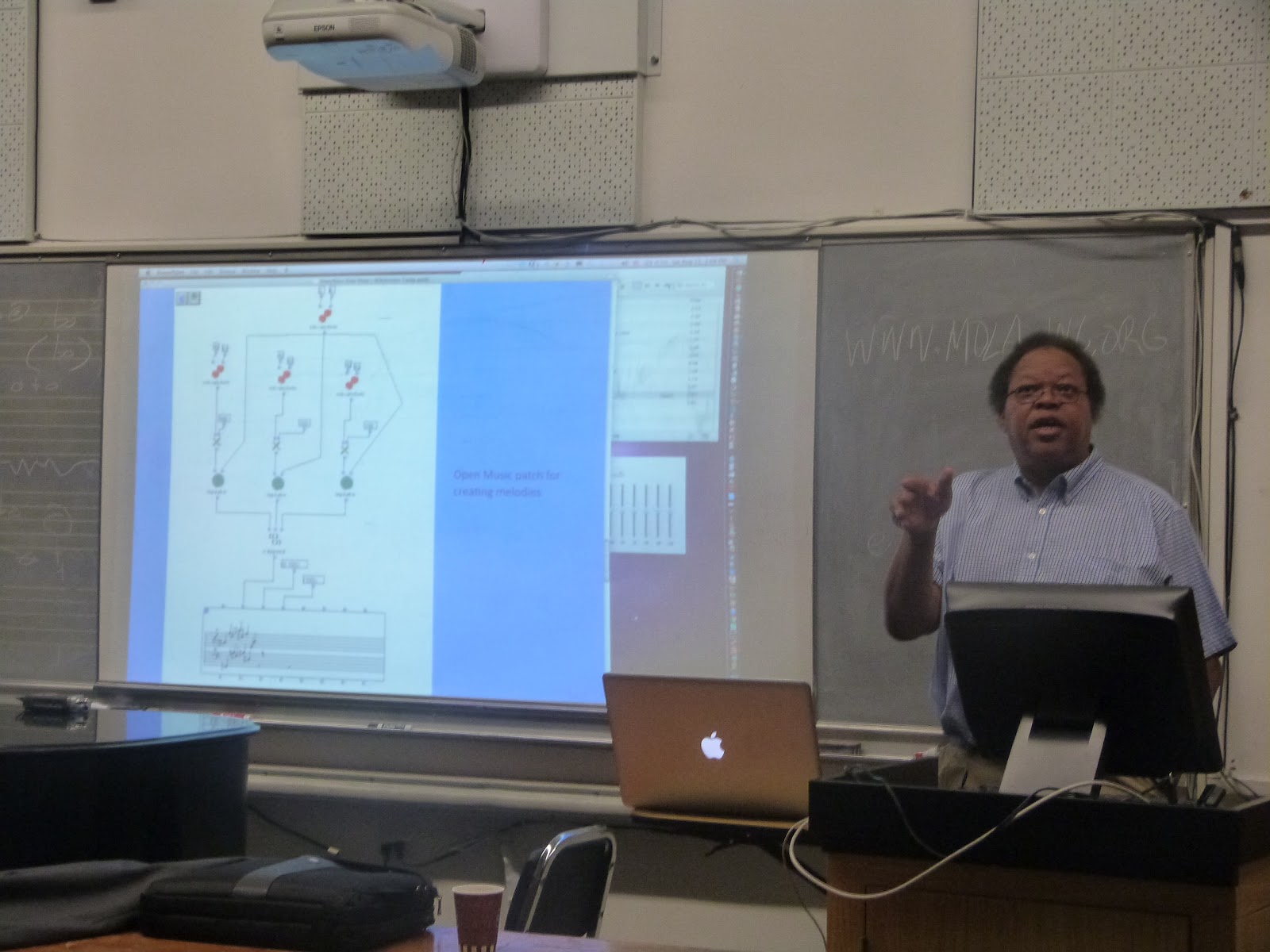
This morning George Lewis gave a class on "electronics and the orchestra." It was partly his own theorizing about our relationship to technology in broad terms, and partly a discussion of process-oriented techniques involving interactivity, spectral tools, and other topics far less familiar to JCOI participants than other technologies he didn't cover such as DAWs, synthesizers, and notation software. It was really useful to open up the imagination and get everyone thinking about future possibilities, even if these are techniques that none of us will be able to implement anytime soon given practical constraints. One point he made was that there are fairly few recordings of orchestral pieces involving electronics, something I imagine will change gradually, but still struck me as odd given how long electronic music has been around and how central it is to musical life today. I suppose this just goes to show how successfully the orchestra as an ensemble insulated itself from change in the 20th century, even if composers did develop all kinds of new compositional strategies in writing for it.

After George's talk was a presentation on engraving and copying by one of the librarians from the LA Philharmonic, Stephen Biagini. He gave a helpful rundown of all kinds of practical information about how to prepare scores and parts for orchestra, as well as common errors and examples of what not to do - the funniest example being a flute part in which the instrument name was appended to the title of a song called How Deep Is Your Love. His detailed advice on how to prepare parts properly was very serious, though, given the time pressures that you're under in rehearsals with any professional orchestra. He pointed out that by his rough calculation, the cost of rehearsing with the LA Phil is about $300 per minute.

James Newton gave the final presentation after lunch, and I was moved by the fact that James said he had to completely rework his presentation after talking to everyone during the week, since that gave him a better sense of what needed to be addressed. James is an incredibly dedicated teacher, and it really comes through in his presentation style as well as the content. His presentation included not only some good practical advice about how to get started writing for orchestra, but also reflections on a wide range of artists that have been important, personal touchstones for him in his own search to discover his voice as a composer. These included spirituals and Hendrix as well as Mingus, Ellington, Mahler, Ravel, Lutoslawski, Ornette Coleman and several others. One point he made that intrigued me had to do with Ravel's relationship to jazz. It's well known that Ravel was influenced by early jazz, but like many others, I had always thought that Ravel's exposure to actual jazz music was fairly superficial. James cited the book Ravel Studies which apparently details how Ravel studied early jazz deeply through private instruction with a jazz trombonist. James also made an interesting claim that most performances of Ravel's music - specifically the Piano Concerto in G Major - have not adequately captured the spirit of this connection. As with so many of the faculty presentations this week, this left me with several topics that I'm curious to explore more in the future.

ACO executive director Michael Geller offered an great, impromptu session on commissioning during our lunch break, full of information that will (hopefully!) be useful to us someday. The final session included a run-down of phase two of this JCOI project, in which all of us - and previous JCOI participants - are invited to apply for the opportunity to have a work read next spring/summer in four intensive sessions that they're now organizing. Although it will be competitive to get accepted, everyone I spoke to was very grateful for the potential opportunity to take forward all the experiences we had this week and put them into practice.

The week ended with a superb concert by wild Up featuring works by all the faculty composers as well as several others. The performers did an amazing job of capturing all the different aesthetic worlds that were represented on the very diverse program. They all seemed to really enjoy themselves and projected a great vibe, like a tight band. They also brought out a large and enthusiastic crowd, which is not easy to do in LA for contemporary chamber music. They're in residence right now at the Hammer Museum so if you're in LA, check them out in the coming months there. For anyone new to contemporary classical music, I can't think of a better way in. Many thanks to Chris Rountree and all the wild Up musicians, many of whom also gave us excellent instrument classes during the week.

I also want to express my deep gratitude to the ACO, especially Michael Geller and Greg Evans who were on the ground organizing constantly all week; to the faculty artists, who not only taught great classes but participated in one another's sessions throughout the whole week, creating a great feeling of community; and to all the other participants, almost all of whom had to travel a lot farther than me to get here, and made this such a friendly and exciting event. It's just a start, but a powerful one, and I look forward to seeing what will emerge from all the possibilities that the past week has set into motion. Many thanks!

Friday, August 10, 2012

Jazz Composers Orchestra Institute Days 2 & 3 - Michael Dessen

Jazz Composers Orchestra Institute - Days 2 & 3
by Michael Dessen

Reading Samantha's wonderfully detailed account of day one, I realized that I didn't introduce myself at all in my first blog entry. I'm a trombonist and composer, and you can find out more about me here. But I should offer a full disclosure here that I came here already knowing a number of the JCOI faculty artists, especially George Lewis and Anthony Davis, who have been important mentors for me since graduate school. Nicole Mitchell is also my colleague at the University of California, Irvine, where we're both core faculty in an MFA program in Integrated Composition, Improvisation and Technology, and I know several
other members of the JCOI faculty, so I may not be the most impartial observer.

Last night we had a second marathon session in which the participants each shared a short recording or performance to introduce themselves. As with a similar session the previous night, I was impressed with how many people stayed late for this, including many of the faculty. Given how balkanized music worlds can often be, it was also encouraging to see everyone listening intently and respectfully for three hours to such a wide aesthetic range of
works.

While building on the positive energy of day one, the plot has definitely thickened over days two and three as more complicated questions emerged. There is always plenty of practical information to deal with, such as in the instrumental classes offered by members of wild Up, but on a deeper level, it's now clear that JCOI is about much more than learning orchestration techniques. Over the past two days, we've heard presentations by many of the
composition faculty - Alvin Singleton, Nicole Mitchell, Anthony Davis, James Newton, Paul Chihara, Anne LeBaron and George Lewis - and this has enlivened the conversations happening both inside and outside the classroom. The threads are still coming into focus for me, but I'll try to sort out a few below.

Anthony Davis gave a presentation yesterday on his opera Amistad, and it seemed that many participants who weren't familiar with his music were knocked out by it, especially his command of the orchestral medium. Anthony described how he now hears the orchestra naturally when he writes at the piano, telling us "I don't even hear the piano anymore." He related this to Duke Ellington, pointing out that Ellington honed his orchestra over the years like a very personal kind of instrument, and he pushed us to each consider what it would mean to do the same, to use the orchestra to realize our individual music, rather than to simply take a "generic," safe approach.

But both in that session and in later conversations, several people shared a feeling that this challenge is more daunting than it might seem. We all know that orchestras are hardly hotbeds of innovation in performance practice; pieces get very limited rehearsal time, and most professional orchestra players are far less open to working on new approaches to performance than musicians in new music chamber ensembles. Anthony's insistence that we should be cultivating individuality and using our writing to "set new standards" that future orchestral players will have to meet was inspiring, but I'm pretty sure he'd also be quick to admit how difficult it is to get the culture of orchestra or opera worlds to open up to new ideas or methods (the innovative projects of the ACO notwithstanding). Just get Anthony
started on this topic and I promise you'll be in for a lot of stories! So as one participant put it to me later, if barriers in that sense still exist for someone of Anthony's stature, imagine how an orchestra would react to less established composers like us arriving with parts that involve cultivating new performance practices or sensibilities. This isn't to dismiss Anthony's message, but to clarify that JCOI represents a more complex, long-term, and fundamentally cultural project than it might seem on the surface.

The instrumental demo sessions we've had with wild Up members reflect this same creative tension in a different way. On the one hand, it's exciting to engage with these performers; they're part of a generation of virtuosic musicians who are dedicated to collaborating closely with composers on new methods. Naturally our discussions in these sessions often go into questions of extended techniques, since they're as eager to talk about those topics as we are. But then, suddenly, someone will shift gears and remind us that in the case of orchestras, we need to be a lot more careful about what we try. In one session, wild Up's director Christopher Rountree even pointed out that some orchestral musicians have contracts specifying that they will not be required to perform certain extended techniques like multiphonics.

I don't mean to be overly negative, since I think the possibilities we're all pointing towards are genuinely thrilling, if still embryonic. But it's still a very loaded set of questions for me and many others here. Today, for example, a fellow participant expressed to me a deep concern that in moving into a more conventional model of notated composition, we risk stripping something essential from the musical value system that is bound up with collective, improvisatory performance traditions.  How we can bring to orchestral composition something genuine and powerful from our experiences as improvisers, and what are the different challenges - logistical, economic, technical, aesthetic, cultural - that come with this process?

Both James Newton and Nicole Mitchell gave inspiring, positive talks yesterday on this topic, and each spoke about seeking ways to compose fully-notated or orchestral music while drawing on what we value from our experiences as improvisers. James' stance hit me hard when he spoke of the decades of collaborative and individual practice that improvisers go through in order to access a very special kind of musical, even spiritual experience "on the bandstand." He seemed to be saying that having cultivated this feeling through years of hard work now enables him to step back study it analytically, and to explore techniques for translating it into new forms via notated composition. Nicole also spoke eloquently about this exploration in terms of "expansion" rather than giving anything up, pointing out that you don't have to stop being an improviser as you move into studying new forms of composing. Both Nicole and James brought out the importance of envisioning alternate future realities in our work as composers, and played moving examples of their own recent compositions while humbly pointing out that this is a long, ongoing project for them that in some sense is just beginning.

The other composers' presentations were equally inspiring for me, though each in a distinct way. Alvin Singleton played several of his pieces and talked about not only the music, but also his personal pathway to becoming a successful independent composer, from growing up in Bed-Stuy in Brooklyn and sneaking out of his parents' house in high school to go hear Ornette Coleman's first band in NYC, through various schools and many years establishing himself in Europe to finally make his return back to the states. One of the younger participants commented that she appreciated his story as a reminder that finding one's way as a composer is not necessarily a straight line from point A to B, as formal schooling systems would have us believe. This resonated with me because I teach grad students who often express a similar feeling of being overwhelmed by pressures - both real and self-created - to codify their artistic identity and broadcast it at every online corner before they hit their mid-twenties. Hearing someone as experienced as Alvin talk about composing in the broader context of his life is always a very memorable part of these encounters. This was also true for Paul Chihara's energetic presentation this morning, which was hysterically
funny - he could easily work as a standup comic. But underneath the humor, Paul's talk was also filled with provocative ideas and reflections on his long career in film music, including fascinating asides on Los Angeles music history, Hollywood, Takemitsu and many other subjects that seemed to burst out unexpectedly in every moment.

To close out today, we had intense sessions with Anne LeBaron and George Lewis, each sharing some of their recent works. While totally different from one another, Anne and George both presented music and ideas that I think pushed some new envelopes we haven't encountered yet this week. Their session was powerful for me personally, and set a perfect stage for tomorrow, but I'm out of time so I'll have to return to that in a future post. I look forward to more dialogues with everyone!

Wednesday, August 8, 2012

Jazz Composers Orchestra Institute Day 1 - Samantha Boshnack

Jazz Composers Orchestra Institute - Day 1
by Samantha Boshnack

My name is Samantha Boshnack, I am a trumpeter/composer living in Seattle, WA.  I just had the most incredible day.  Today was day 1 of a five day intensive for jazz composers living all over the country to learn about writing for a symphony orchestra.  That may have been the starting point, but we learned about much more than that.

A little background on myself, I play all kinds of music on the trumpet.  For the last 8 years or so, I have been writing for Reptet the instrumentation is four horns, bass, and drums.  This past year and a half, I added to that B’shnorkestra a 13-16 piece orchestral project (with rhythm section) and Sam Boshnack Quintet (trumpet, clarinets, piano, bass and drums).  I guess I fall into the jazz realm as a composer but I draw from a lot of things.  
I really had no idea what to expect going into this intensive.  I knew that it was probably going to feel crazy to be surrounded by so many other composers.  And it was - crazy in a really inspiring way.  To be around so many who are trying to create something new and putting their whole lives into their vision; in a world that can sometimes feel like it doesn’t care much about innovation or sophistication in music.  As I looked around and interacted with the peers and faculty throughout the day, I could see the hunger in everyone’s eyes to soak up as much as they could from this experience.  I could sense that it was refreshing to all of us to be surrounded by others working in such a tough field, a kind of comfort in numbers.  Even though we were from different parts of the country (and some had or do live abroad) we all had so much shared experience and so much to talk about. 
  
As I write this I have to apologize for any mistakes I may make and/or ideas that I can’t quite convey right now.  It’s midnight and I have been on a rollercoaster ride of ideas all day and heard so much that inspires me.  So I’m going to sketch some stuff out tonight, and hopefully can continue to develop on themes throughout these days.  I can tell already that certain ideas will probably resurface over and over.   

We started at 9 a.m. with a welcome from George Lewis and Michael Geller.  Then we jumped into orchestral evolution with Derek Bermel. Derek is a composer that I started listening to when I got the list of faculty for this intensive and his music totally blew me away.  I hadn’t been that excited by a new orchestral piece in a long time.  He had a 90-minute presentation planned out for us that took us through many orchestral pieces spread over hundreds of years.  We heard Gluck, Haydn, Beethoven, Tchaikovsky, Debussy, Stravinsky, Ligety and more.  It truly was a whirlwind and it was great to spend time listening and studying scores.  We also learned a lot about history, instrumentation, and the personalities of the composers. We learned that the orchestra as an ensemble has gotten more specific in its instrumentation.  In the beginning, orchestral composers would be less specific, or write for what they had, or what could fit in the space - more than a standardized instrumentation.  That has changed over time into what we think of as the orchestra. 

It was interesting to think about how the course and history of the outside world affects what movements of music are picked up and which are forgotten.  Also how the development of the instruments themselves affects how music is written.  Over the course of the day we learned both how the composer pushed the instrument into new territory, and how sometimes it's the other way around.  

As someone coming into this who is pretty self-taught when it comes to orchestration, it was so great to hear things that I had come to myself, but never known if they were true. 
Some notes I took during Derek’s speech were:

-Each instrument is like speaking a different language, each section is too. 
-In an orchestra the strings are the driving rhythmic force and the percussion is ornamental. 
-Great composers are great orchestrators. 

Paul Chihara gave us an incredible presentation filled with his music, the music of others, and lots of life stories.  He said a few things that stuck with me such as, “We don’t make choices”.  His story as a composer seemed like a wild road filled with lots of amazing opportunities.  

He called himself a film composer.  He spoke about technology and how much that has changed music.  Composition was created around the idea that musicians perform it live.  Because of technology, now that is no longer always the case.  

James Newton played an incredible piece of his for us called “Looking Above, The Faith of Joseph” written for solo piano.  He explained to us about a method he created called “The Transformed Entrance” where he instructs the performer to “channel” famous performers like Cecil Taylor or Elvin Jones.    

I was excited by his quest to bring the improvising tradition into the new chamber and orchestral music world.  Also, I loved hearing him stress that we should look at our time on the stage, and how it affects you as a composer.  The excitement of live improvisation – how can we bring that into notation?  This is what “jazz” composers bring new to the table and it felt important that we were all trying to figure out how to best tackle it.    

Members of the ensemble “wild Up” did presentations on the violin and the oboe, clarinet & bassoon.  Wow, these performers were incredible.  To be honest they did things on there instruments I didn’t know were possible and taught us all so much, giving us ideas on how to write for them.  It made me really excited for their performance on Saturday.  

After all of this, we continued on until 11 pm (with some breaks) listening and sharing scores.  About half of us presented.  There was seriously some amazing music played from prodigies to established composers and many in-between.  Everyone was very supportive of each other it was a lot of fun.  

Like I said, I think tonight’s writings will be truly tip of the iceberg.  In my current state of exhaustion, there is no way I could accurately convey the amount of ideas I will be mulling over for years to come or the excitement that was in the room.