Showing posts with label Raymond J. Lustig. Show all posts

Wednesday, March 27, 2013

coLABoratory: Lab 5 - Ray Lustig: Before the Lab


Ray Lustig

The latest of the workshops for Latency Canons was the first time I brought musical material that I knew would actually be going into the piece.  For the previous two workshops, I'd come with only fragments of music for testing out the dynamics of playing with delay under various scenarios (a conductor in New York conducting players in England, vice versa, no one conducting and the players just following each other by sound, or by sight only, etc. etc.).  And I actually ended up using none of that early fragmentary material in the final score.

But those early workshops were essential in helping me to figure out what kinds of material would work well, for showing me what scenarios of the imitative setup were likely to yield interesting results (or even be practically possible), and helping me get to the heart of what it was I wanted to do with this idea.
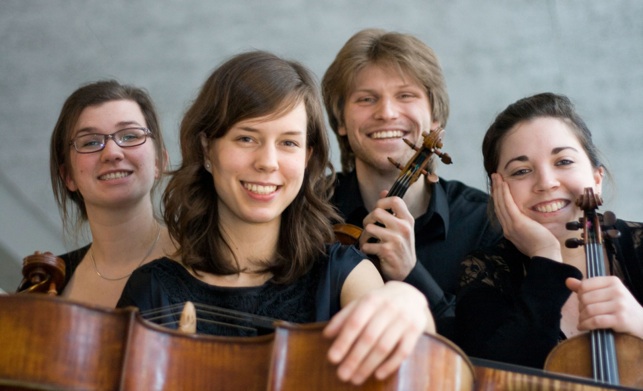
Gildas Quartet
Latency Canons is in some ways a concerto for string quartet, but the onstage string quartet is replicated in three other places (the furthest of which is the Gildas Quartet in Manchester England) that will all be in communication via GoogleHangouts.  The latency (delay) of the internet connection will hopefully allow the remote quartets to create a halo of resonance and reverberation around the onstage players' music.  This unstable and multipart echo made me think of a ritualistic recitation, as congregants chanting in a strange cathedral that wraps around the world all the way to Manchester England.

Dan Lame
The piece opens with only the onstage quartet playing.  Then the offstage quartets join in imitation.  The orchestra joins with its own imitations, and the piece becomes a conversation between the orchestra and the "canonists" of the four quartets.  Eventually conductor George Manahan passes the baton to conductor Dane Lam on the other side of the Atlantic.
 
The piece ends with the onstage players gradually dropping away, until only the offstage players are left playing.  The music that started on Zankel Hall's stage has drifted out into the world.

Friday, March 8, 2013

coLABoratory: Lab 1 - Ray Lustig: After the Lab


Raymond Lustig & George Manahan
It's pretty amazing that one can actually just get together with an important orchestral ensemble and play around with ideas like teenagers in a garage band.  Crazy fun, and an amazing learning experience.

Here's some of what we learned:
Well, we knew this already, but technology continues to be the dog in musical performance, even though we're trying to use something no more complicated than Google Hangouts, something designed to be the most reliable, user-friendly software.  We had trouble linking up with our Manchester partner Dane Lam until the very end.  But at least when we did, it was really informative.

We learned that the transatlantic link to Manchester seems to a good deal slower, stickier, uglier, which is great!  This is what we're looking for, the problems, the limitations of the technology.

Raymond Lustig & Derek Bermel
Most of my test canons yesterday were swirly in continuous note values throughout, but Derek Bermel encouraged me to do more with canons of greater textural variety within, periodic aural landmarks that the listener hears go by at different times in each voice, and that can create their own polyphonic independence of voices.

I'll probably include some sweet diatonic (scaler) canons in the set, but diatonicism under aleatoric circumstance just becomes pan-diatonicism (all the notes of the scale), whether the delay is 1 beat or 10 beats.  Pretty, but the degree of delay doesn't really make much difference to the sound.  More interesting for me are canons in which the degree of delay changes the music by degrees, so most of my canons to date cycle through the keys via the circle of fifths.  Thus when delays are short, the music sounds diatonic and consonant, but as delays get longer, the sound gets crunchier and spacier as the voices get into more and more distant key relationships.  I like this because it makes the degree of delay matter a lot in the musical result, rather than delay being merely this random offset of music that would sound more or less the same with a long or a short delay.  That said however, sonic variety between the various canons might suggest having some diatonic canons interspersed in the complete set.

George Manahan conducts remotely
Much of what we learned was about the setup possibilities of who is where, who is playing what, and who is following which conductor.  Morton Subotnick suggested two interesting possibilities: Crossing conductors (having onstage players follow a remote conductor, and remote players follow George Manahan onstage at Zankel Hall), and choose-a-conductor (individual players choose which of the conductors to follow, which actually helps because some of the players, like the harpist, have trouble seeing the screen from the stage, and could therefore just follow their local conductor).  But in the end we agreed a variety of conformations, specified in advance in the score, will probably be best.

Plus a lot of other things.  But that's all for now.

Thursday, November 15, 2012

coLABoratory: Lab 1 - Ray Lustig: Before the Lab


I'm really excited and grateful that ACO is giving me the chance to indulge a nagging little curiosity of mine.  I've seen some really interesting concerts where musicians have played together with other musicians in faraway places via the internet.  It's always a huge feat of technological wizardry, cutting-edge equipment and software, and enormous expense, and, despite the brilliance of so many who worked so hard, there are often still glitches, mishaps, and outright connection failures, and the musical statement sometimes suffers under the strain of technological limits.

So I wondered what would happen if you just embrace the limits of technology, and even try to make them the most interesting part.  What if instead of using highly specialized cutting-edge technology, you used really basic, but more-or-less-reliable, videoconferencing software like Skype, Google Chat, or Facetime?  Consumer level stuff.  Free, and easy to use.  Yes, there are those unpredictable delays, and mismatches between sound and picture, freezes, and catch-ups, but what if instead of trying to eliminate them, or write music whose texture isn't disrupted too badly by them, one decided to make these mishaps the very thing that makes the work interesting?

My new work for ACO, Latency Canons, uses these unpredictable problems as "canons" (rules).  When we sing in rounds, or canons, there's that time delay between two or more versions of the same music:  "Row, row, row your boat.  Row, row, row your boat." Composers have always enjoyed riffing upon this simple game of making "rules" for musical self-similarity--two or more versions of the same thing set apart by some strict law--the second one follows the first by one measure, or 5 measures; the second is like the first but higher; the second one is upside down, or backwards, etc. etc. etc.--but still sounding good.  Different keys, flipped, flopped, multiplied, stretched, compressed, and so on and so on. So, I decided to use the bi-products of technological limits--unpredictable delays, picture-sound mismatches, freezes, and more--as unpredictable canonic "rules," to make highly unstable canons.  Music that would otherwise be fairly simple, and perhaps even uninteresting, becomes interesting because of the technological limits.  What if you're playing online with musicians uptown who are delayed by 1 second at the same time that musicians in England are delayed by 5 seconds?  And what if those times are constantly changing around?  What if the musicians are trying to follow each other but the visual cues and the sound aren't aligning?  What if an onscreen conductor suddenly freezes on beat 3, but only for some of the players?

For me it's about embracing imperfection, or at least questioning how perfect we really want or need our technology to be.  The mighty supersonic jet Concorde, which once made it possible for the general ticket-buying public to cross the Atlantic in under 3 hours, was once seen as the way of the future. But it went broke. Not enough people needed it badly enough to shell out the huge bucks for the flight. The technology existed, but it was more than we needed or could afford, at least for now.

Could the zero-delay, crystal-clear, perfect internet video connection be an ideal that we might eventually give up on too? Maybe we'll be okay with the delays. For now at least, I am. 

Your guess is as good as mine how this will turn out, but it should be great fun to see what happens.  Will it be soaringly free polyphony, a musical train-wreck, or some gorgeous combination of both? A risky experiment like this is something that would scare off any sane orchestra. So, many, many thanks to the whole fantastic team at ACO for their incredible sense of adventure, unrelenting enthusiasm, and great creative spirit!

Thursday, November 8, 2012

coLABoratory: Playing It UNsafe Composers

We are just days away from the first of five FREE and open to the public laboratory workshops as part of the coLABoratory: Playing It Unsafe program, the first and only research and development lab for cutting-edge new American orchestral music encourages composers to do anything but "play it safe." A season-long collaboration will allow composers Du Yun, Troy Herion, Raymond J. Lustig, Judith Sainte Croix, and Dan Visconti, to create new music of no-holds-barred experimentation. The first of five free public lab-workshops is Tuesday, Nov. 13 at Mannes College for Music. The project culminates April 5, 2013 at Zankel Hall. You can read more about the program and make your reservation by clicking HERE. Also check out the coLABoratory video and audio excerpts from each of the composers on the page. To give you a little tast of what these emerging, experimental composers will be doing I wanted to post their short program descriptions. Enjoy! 

Du Yun:  Slow Portraints 
In today’s world, a massive amount of products are digitally altered, our senses are over-loaded, hyper fast, and hence, altered and mutated. For this project, I would like to challenge myself to investigate a frozen point for the orchestral sound, a gradient palette underneath a hyper slow movement.

In summer 2011, I made a sound design for visual artist David Michalek’s “Portraits in Dramatic Time.” It is a video installation that used ultra-high-speed, high-definition cameras to record several well-known theater and film performers in a scene. In other words, the visual sequences were not digitally altered. The project slows the frames to display each emotion in larger-than-life detail as it is projected onto a screen that’s 85 feet wide and 45 feet high. The work was presented as part of Lincoln Center Festival, utilizing the façade of the David H. Koch Theater as a media canvas. 

While the music, mostly as sound design at the time, was broadcast over wifii to the public, I was hoping I could write for an acoustic chamber orchestra to truly investigate the detailed nuance relationship between the acoustic world and the visual processing image, that both are not digitally altered a bit. For the music, I wonder what I could do to showcase a frozen phrase, elongated gestures elongated, without any digital aid.  Like a glacier, things are never quite frozen. Within these constraints, dramatic narratives were condensed down to an essence.

Michalek’s Portraits are 40 shorts, I’m choosing two shorts to write for ACO. Months ago, someone took the Alan Rickman’s short off from David’s website, uploaded on YouTube, without consent. The shots were reached beyond 10, 000 hits over night. The said person took music from the movie Inception and it seems that people loved it. Now things get particularly interesting for me.  I decided to choose that same short again, diffusing the boundaries between to the viral and the real world. The first short featuring the Chinese Kunqu Opera singer, Qian Yi. 

Troy Herion:  New York City Symphony 
What happens when a composer becomes a filmmaker? The elements of music—phrasing, counterpoint, rhythm, harmony—are made visible. 

New York City Symphony is a visual-music film and composition that unites contemporary orchestral music with images of New York’s urban landscape. Inspired by synaesthesia—where one sense becomes intertwined with, even indistinguishable from, another—this composition invites the audience to see sound and hear images.

As composer/filmmaker, Troy composes music with images in ways similar to composing with sound. Colors are organized as chords, shapes move as melodies, and visual dissonances strive for resolution. Compositional ideas travel between orchestra and film in perceptible ways, achieving a larger canvas where music can play out visually, aurally, and sometimes as a new, combinative element. Finding inspiration from early 20th-century city-symphony films, New York City Symphony will treat the living, breathing organism of the city as its subject. Seen through the eyes of a composer/filmmaker, the metropolis is transformed into a multi-sensory musical symphony. 

Raymond J. Lustig:  Latency Cannons
Ray will create a new project that explores the indefinite time-interval and incremental canons that can arise from latency–the slight, and often unpredictable, delay in signal transmission. Though musicians today are certainly using videoconferencing to play ideas for one another, it hasn't yet taken off as a way for musicians living apart to actually play together because of the lingering problem of latency.

For musicians remotely playing together via videoconferencing, and responding to both visual and audio cues, each of which may have its own unstable degree of latency, it would be impossible to stay together. Ray's piece will capitalize on latency, using unpredictable delays experienced through ordinary videoconferencing as its canonic time intervals. The cycle of lateness would be ever-increasing, as each musician tries to play along with the delayed version of what their remote counterpart has played, in an unstable feedback loop.

This will work with parts of the orchestra onstage while other parts are offstage on camera, possibly even in another city, country, etc. and possibly, with a sister ensemble or players in a faraway place. The piece would require two or more laptops (depending on the number of "voices" in the canons) equipped Skype or a similar videoconferencing application, microphones, amplification, and AV projection to an overhead screen that would allow the players and the audience members to view the voices of the canon. 

Judith Sainte Croix: Vision V
Vision V by composer Judith Sainte Croix will integrates three non-orchestral instruments into the orchestra - the populist electric guitar, ancient pre-Columbian flutes and the non-ordinary sound palette of the synthesizer. “Events” containing textural freedom will contrast with moments of rhythmic and contrapuntal precision.

The development of the “events” envisions musicians, conductor and composer as a collaborative community designing musical equivalents for terms like “infinitude” and “joy.” Abstract digital imaging suggesting the auras of the musicians photographed during rehearsal, will play along with the music in the concert. The music will literally extend into the audience in the penultimate moments when concert goers will be invited to participate. 

Vision V is the fifth in a series of compositions by Ms. Sainte Croix that combines traditional classical instruments with indigenous instruments of the Americas. The Sonora Trio  - Andrew Bolotowsky, indigenous flutes of the Americas, Oren Fader  electric guitar and Judith Sainte Croix, synthesizer will perform with the orchestra. The abstract digital images will be derived from photography by Claudia Miranda with design support from Marcelo Mella. 

Dan Visconti:  Glitchscape
My new work in collaboration with experimental filmmaker Simon Tarr will blend instruments of the orchestra with sounds from obsolete analog technology. My earlier compositions have been inspired by the artifacts of sound production, but this new work for the American Composers Orchestra will explore the interaction of live acoustic instruments and technology on a much larger scale, featuring parts designed to be performed on modified vintage Speak & Spell and Speak & Read toys and an old 50's "noisebox" that will integrate with traditional orchestral parts and video. The piece will explore the audio/visual interactions of these electronic devices with extended orchestral techniques informed by the same affectingly crude electronic timbres.

The composition will employ a visual element allowing me to express ideas in a new way leading me to new sonic landscapes. The new work will create a unique texture through reimaging familiar, nearly-forgotten sounds: an exploration of the expressive power of obsolescence.