Showing posts with label Christopher Rountree. Show all posts

Thursday, March 14, 2019

EarShot Sarasota Orchestra - Composer Spotlight: Sam Wu

The music of Sam Wu deals with the beauty in blurred boundaries. From Shanghai, China, Wu attends The Juilliard School for his M.M., after receiving an A.B., with honors, from Harvard University. His teachers include Tan Dun, Robert Beaser, Chaya Czernowin, Richard Beaudoin, and Derek Bermel. Wu also has been featured on the National Geographic Channel, Business Insider, Harvard Crimson, Yale Daily, Asahi Shimbun, People’s Daily, China Daily USA, SinoVision, CCTV, and ICS, among others.

Sam's piece Wind Map was selected for the EarShot Sarasota Orchestra New Music Readings, where it will be rehearsed and performed under the direction of conductor Christopher Rountree. A reading session on Saturday, March 16, 8PM is open to the public at Holley Hall. Click here for more information.

We spoke with Sam about his piece and the EarShot program.

Composer Sam Wu

American Composers Orchestra: What was your reaction to finding out your piece had been selected for the Sarasota Orchestra EarShot New Music Readings?

Sam Wu: I was thrilled! It is a rare opportunity for young composers to hear their orchestral music played live, particularly by an ensemble of as high a caliber as the Sarasota Orchestra. I also really look forward to meeting my amazing peer composers and our esteemed mentor composers!

ACO: You write that Wind Map was composed with inspiration from a graphic visualization of global wind patterns, in which empirical data results in aesthetic beauty. Are there any examples in your piece of this same process, in which the input (pitches, note-lengths, or dynamics, for example) came from rigid, empirical data, but resulted in something much more artistic?

SW: Not really! I did not think as much of producing direct musical "analogies" of the empirical data. Rather, I wanted to perhaps "reinterpret" the swirls and colors of the wind map in musical form; in general, once I feel that I have a source of inspiration I want to explore throughout an entire piece, I keep it in the back of my mind as I think more abstractly / in musical terms as I start writing.

View the live graphic visualization of global wind patterns at earth.nullschool.net

ACO: What are you doing to prepare for the readings? Are there any changes you have made to your piece?


SW: Besides some minor instrumentation changes, I also shortened a few bars, and played with some harmonies in the climactic session. I was lucky to hear this piece read by the Juilliard Orchestra last fall, so I based my edits off of that reading recording.

ACO: What are you looking forward to about the workshops and readings? What do you hope to learn from the experience?

SW: I really look forward to hearing and studying the other pieces being read! I feel that, in addition to lessons with teachers, I also learn so much from my friends and peers (both their works, and how they contribute in rehearsal settings). I'm sure that I will feel the same way when I'm in Sarasota. I also am excited to learn more about the "behind-the-scenes" work of a professional American orchestra -- ACO and Sarasota organized various career development Q&A sessions with the Sarasota staff in addition to the readings and feedback sessions themselves.

Words cannot describe how grateful I am to be able to participate in EarShot; a HUGE thank you to everyone at ACO and the wonderful Sarasota Orchestra for making all this possible for us!

Sam Wu's piece Wind Map will be performed by the Sarasota Orchestra, led by conductor Christopher Rountree, on Saturday, March 16, 8PM at Holley Hall. Click here for more information.

Learn more about Sam Wu at www.samwumusic.com

Wednesday, March 13, 2019

EarShot Sarasota Orchestra - Composer Spotlight: Kitty Xiao

Kitty Xiao ​is an Australian composer, pianist, and collaborative artist based in Rochester, New York. She is currently completing a Master of Music (Composition) at the Eastman School of Music as a graduate award recipient, studying composition with Robert Morris and piano with Tony Caramia. Xiao is founder, composer and pianist of Nimbus Trio and released her first album ​Novum​ in 2016 as a represented artist of Move Records label. In 2017 Kitty formed the Six Piano Collective and is Artistic Director of the ​Six Piano Project​. The same year she launched a new concert series ​NoiseSense​. 

Kitty Xiao's piece Ink and Wash was selected for the EarShot Sarasota Orchestra New Music Readings, where it will be rehearsed and performed under the direction of conductor Christopher Rountree. A reading session on Saturday, March 16, 8PM is open to the public at Holley Hall. Click here for more information.

We spoke with Kitty about her piece and the EarShot program.

Composer and pianist Kitty Xiao

American Composers Orchestra: What was your reaction to finding out your piece had been selected for the Sarasota Orchestra EarShot New Music Readings?

Kitty Xiao: Excitement to work with and meet everyone!

ACO: You write that your piece Ink and Wash is inspired by Chinese calligraphy and the work of New York-based artist Gu Wenda. Can you talk about any particular works of his that inspired the piece? How does the meaning of the characters, in addition to how they look, fit into the inspiration you take from these works?

KX: I am interested in the energy, gesture, and intent in the practice of the tradition. His works Negative and Positive Characters and Tranquility comes from Meditation liberate themselves from traditional technical and aesthetic structures, and often rearranges Chinese characters over surreal splashed ink landscapes. I was drawn to the way in which Wenda works with a past tradition to create new ways in questioning the present and the future.

Negative and Positive Characters by Gu Wenda

Tranquility comes from Meditation by Gu Wenda

ACO: What are you doing to prepare for the readings? Are there any changes you have made to your piece?

KX: I am currently familiarizing myself with my piece again, as I finished composing it in November! There's a part of me that wants to keep it completely fresh for the first time I hear the orchestra read it, but I also want to be there and being able to address any part of the score. I expect the first reading will reveal much of any changes that will be required for the performance. I think the feedback will be extremely valuable for developing my orchestral writing whether I choose to further develop this piece or any future projects.

ACO: What are you looking forward to about the workshops and readings? What do you hope to learn from the experience?

KX: I think the workshops and readings will open up great discussions about topics of orchestration and also challenges and solutions for composers working with orchestras. It's going to be wonderful receiving the support and conversation with the mentor composers.

Kitty Xiao's piece Ink and Wash will be performed by the Sarasota Orchestra, led by conductor Christopher Rountree, on Saturday, March 16, 8PM at Holley Hall. Click here for more information.

Learn more about Kitty Xiao at www.kittyxiaomusic.com


EarShot Sarasota Orchestra - Composer Spotlight: Nicky Sohn

From ballet to opera to Korean traditional-orchestra, the wide-ranging talent of composer Nicky Sohn is sought after across the United States, Europe, and Asia. Characterized by her jazz-inspired, rhythmically driven themes, Sohn’s work has received praise from international press for being “dynamic and full of vitality” (The Korea Defense Daily), having “colorful orchestration” (NewsBrite), and for its “elegant wonder” (Frankfurter Allgemeine Zeitung), among many others. As a result, Sohn has enjoyed commissions from the world’s preeminent performing arts institutions, including sold-out performances at the Stuttgart Ballet in Germany, The National Orchestra of Korea, and the New York Choreographic Institute at New York City Ballet.

Nicky's piece Bird Up was selected for the EarShot Sarasota Orchestra New Music Readings, where it will be rehearsed and performed under the direction of conductor Christopher Rountree. A reading session on Saturday, March 16, 8PM is open to the public at Holley Hall. Click here for more information.

We spoke with Nicky about her piece and the EarShot program.

Composer Nicky Sohn

American Composers Orchestra: What was your reaction to finding out your piece had been selected for the Sarasota Orchestra EarShot New Music Readings?

Nicky Sohn: I was absolutely thrilled! Bird Up is the first orchestra piece I have written since being out of school, so it meant extra special to me that the piece was selected for this wonderful program. It is always nerve-wracking, but the most exciting experience is to have my orchestra music in front of each member of the orchestra. So, to be given this opportunity to hear my piece played by the Sarasota Orchestra with the great mentors next to me, I felt extremely excited and honored.

I was also really happy to be able to edit and give my piece another go. The piece was read at the Aspen Music Festival in the prior summer, and there were sections I wanted to edit and fix to make the piece better. It is rare to receive a second chance with an orchestra piece as a young composer, and I was sincerely grateful for this opportunity.

ACO: Your piece Bird Up is inspired by the chaos of New York City, as seen through the lens of Adult Swim's bizarre "anti-talk show" The Eric Andre Show. Do you have any personal experiences with chaos/absurdity in NYC that inspired the piece? Was writing this piece a way to help cope with this aspect of living in NYC, which many people find to be stressful, or are these chaotic moments something that you savor?

NS: Definitely! I lived in New York for 9 years, from the age 15 to 24. Everyday was filled with excitement, but also so much stress and chaos. Now that I look back, I have no idea how I survived through those years. Living in New York gave me so much inspiration and energy, but everyday was also a struggle. Even in my own apartment, which was never really affordable, and extremely tiny, I always felt restless and unsettled. When I moved to Los Angeles, I finally realized laundry and grocery shopping did not have to be such a battle.

Bird Up encapsulates my perspective on the nature of New York City, as seen through the lens of the bizarre humor in The Eric Andre Show. The show reflects the extreme end of the chaos that New Yorkers sometimes encounter with a humorous twist—Eric Andre dresses up in a neon green morph suit and confronts strangers on the street. When planning this work, my goal was to create an orchestra piece that reflect The Eric Andre Show’s prominent attributes—lively, energetic, and most importantly, loud. I wanted to keep the energy up throughout the whole piece, but still have a lot of different orchestral colors and textures. My music tends to be pulse driven and quite rhythmic, and I intended to emphasize and magnify the rhythmic aspect. New York was always dynamic, and full of sounds no matter what time it may have been. I also placed several police whistles and siren in different sections of the orchestra to show the chaotic street scenes of New York.

ACO: What are you doing to prepare for the readings? Are there any changes you have made to your piece?

NS: During the preparation for the readings with the Sarasota Orchestra, I have been learning so much about how many layers of work one needs to put in in order to get an orchestra piece done. This was the first time someone looked through my parts in depth and gave me constructive criticism in part preparation especially on layouts, fonts, and spacing. I have edited my score and parts a lot appearance-wise. I had to reformat the score and the entire set of parts which brought me many sleepless nights, but I am honestly really happy with the result. Moreover, last I heard the piece read at the Aspen Music Festival, I felt the ending needed a little more build up. I added and extended some of the parts. I also adjusted and re-orchestrated a few sections to try different colors and timbres.

ACO: What are you looking forward to about the workshops and readings? What do you hope to learn from the experience?

NS: Collaborating is one of my favorite aspects of being a composer. Composing tends to be very solitary, and oftentimes I feel limited with what I know, what I feel, what I can hear, and what I can express. Having another brain, set of ears, and heart always has been the best part of my work. I admire the music of the mentor composers very much, and of course, Maestro Christopher Rountree is one of the most exciting and inspiring conductors and I am absolutely thrilled to work with them and hear their reaction and ideas on the piece.

Anytime I hear an orchestra play my music, I always get surprised by the energy and the wide range of expression and intensity that gets delivered through an orchestra. I can only use my imagination to estimate the sound and color of each passage when I’m writing the work, but hearing it live has always made me more curious of the possibilities. Orchestra is, of course, the most effective, compelling, and charming tool for composers to expand their music and themselves. Hearing my piece played live helps me so much to grow my imagination and open up and I always end up having hundreds of things I would like to try in the next orchestra piece.

Nicky Sohn's piece Bird Up will be performed by the Sarasota Orchestra, led by conductor Christopher Rountree, on Saturday, March 16, 8PM at Holley Hall. Click here for more information.

Learn more about Nicky Sohn at www.nickysohn.com

EarShot Sarasota Orchestra - Composer Spotlight: Krists Auznieks

Currently pursuing doctorate at Yale School of Music with Aaron Jay Kernis and David Lang, Krists Auznieks’ most recent recognitions include Jacob Druckman Prize from Aspen Music Festival, Latvian National Grand Music Award for the best new work of the year, The Woods Chandler Memorial Prize from Yale, fellowships from Aspen Music Festival, NEXT Festival of Emerging Artists (NYC), Bennington Chamber Music Conference, and Norfolk Chamber Music Festival, winning works at The Chicago Ensemble’s Discover America XI and Kaleidoscope Chamber Orchestra competitions. His quintet “Piano” was featured in The New York Times among the week’s best classical music moments. His opera NeoArctic, co-written with British techno producer Andy Stott, won Danish Reumert Prize and will have its US premiere at The Kennedy Center in 2019.

Krists Auznieks' piece Crossing was selected for the EarShot Sarasota Orchestra New Music Readings, where it will be rehearsed and performed under the direction of conductor Christopher Rountree. A reading session on Saturday, March 16, 8PM is open to the public at Holley Hall. Click here for more information.

We spoke with Krists about his piece and the EarShot program.


Composer Krists Auznieks

American Composers Orchestra: What was your reaction to finding out your piece had been selected for the Sarasota Orchestra EarShot New Music Readings?

Krists Auznieks: I was thrilled: I received the news just a few days before New Year’s Eve and took it as an omen of a wonderful year ahead. The piece taps into something deeply personal and meaningful that I wanted to share with the world and I was hoping that the piece would have life beyond the first performance. The Earshot selection meant that the dream is gradually coming true.

ACO: Can you talk about what you experience when you hear an orchestra perform your music for the first time? What was it like to hear the Aspen Philharmonic Orchestra perform Crossing for the first time?

KA: Oh, it is very exciting: it is a culmination of endless hours of solitary work and hearing it come together in a beautiful place being surrounded by a marvelous community feels extraordinary. It is very healing. The connections that are made during and surrounding the performance — through sound, ideas, presence, and the sheer act of listening — always amaze me. You feel like there are invisible lines connecting history, being, community with something underlying and unspoken and projecting it all into the future. It is closest to time traveling I will ever get. Aspen PO was magical: the care Patrick Summers took, the attention to detail, you just could not believe it. People breathing in sync with fluid, not-having-yet-happened time.

ACO: What are you doing to prepare for the readings? Are there any changes you have made to your piece?

KA: I made plenty of revisions concerning balance, orchestration, and micro-timing; I also changed the last two minutes quite radically. The last section should subsume the rest of the piece completely and I don’t know how it can happen. Can eight minutes of mercurial shifts and crossings be eaten up by a large solid block of late Rothko?

ACO: What are you looking forward to about the workshops and readings? What do you hope to learn from the experience?

KA: I certainly want to find out the answer to my last question. I am looking forward to furthering the changes and getting to know the piece through the ears of other people: composers, musicians, the audience. I am also excited to hear pieces by fellow composers and see how they define and solve compositional problems. Sarasota Orchestra’s extensive experience with the tradition and new music alike is an asset that will contribute to rich interpretation of our pieces in unexpected ways. And what an honor it is to be working with the new music connoisseur Christopher Rountree: his energy and musical literacy are truly inspiring.

Krists Auznieks' piece Crossing will be performed by the Sarasota Orchestra, led by conductor Christopher Rountree, on Saturday, March 16, 8PM at Holley Hall. Click here for more information.

Learn more about Krists Auznieks at www.auznieks.com


Tuesday, August 14, 2012

Jazz Composers Orchestra Institute Day 5 - Michael Dessen

Jazz Composers Orchestra Institute - Day 5
by Michael Dessen

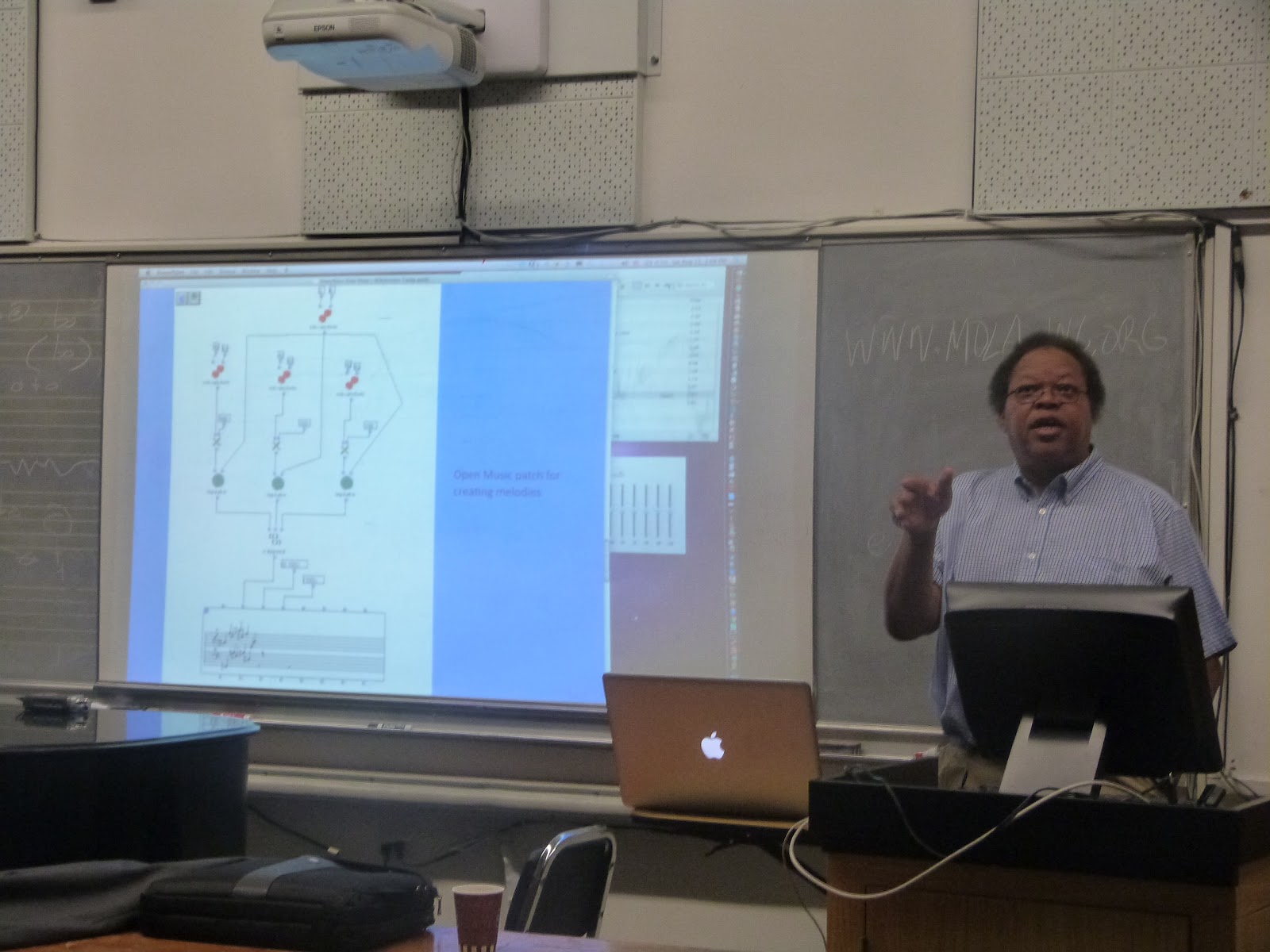
This morning George Lewis gave a class on "electronics and the orchestra." It was partly his own theorizing about our relationship to technology in broad terms, and partly a discussion of process-oriented techniques involving interactivity, spectral tools, and other topics far less familiar to JCOI participants than other technologies he didn't cover such as DAWs, synthesizers, and notation software. It was really useful to open up the imagination and get everyone thinking about future possibilities, even if these are techniques that none of us will be able to implement anytime soon given practical constraints. One point he made was that there are fairly few recordings of orchestral pieces involving electronics, something I imagine will change gradually, but still struck me as odd given how long electronic music has been around and how central it is to musical life today. I suppose this just goes to show how successfully the orchestra as an ensemble insulated itself from change in the 20th century, even if composers did develop all kinds of new compositional strategies in writing for it.

After George's talk was a presentation on engraving and copying by one of the librarians from the LA Philharmonic, Stephen Biagini. He gave a helpful rundown of all kinds of practical information about how to prepare scores and parts for orchestra, as well as common errors and examples of what not to do - the funniest example being a flute part in which the instrument name was appended to the title of a song called How Deep Is Your Love. His detailed advice on how to prepare parts properly was very serious, though, given the time pressures that you're under in rehearsals with any professional orchestra. He pointed out that by his rough calculation, the cost of rehearsing with the LA Phil is about $300 per minute.

James Newton gave the final presentation after lunch, and I was moved by the fact that James said he had to completely rework his presentation after talking to everyone during the week, since that gave him a better sense of what needed to be addressed. James is an incredibly dedicated teacher, and it really comes through in his presentation style as well as the content. His presentation included not only some good practical advice about how to get started writing for orchestra, but also reflections on a wide range of artists that have been important, personal touchstones for him in his own search to discover his voice as a composer. These included spirituals and Hendrix as well as Mingus, Ellington, Mahler, Ravel, Lutoslawski, Ornette Coleman and several others. One point he made that intrigued me had to do with Ravel's relationship to jazz. It's well known that Ravel was influenced by early jazz, but like many others, I had always thought that Ravel's exposure to actual jazz music was fairly superficial. James cited the book Ravel Studies which apparently details how Ravel studied early jazz deeply through private instruction with a jazz trombonist. James also made an interesting claim that most performances of Ravel's music - specifically the Piano Concerto in G Major - have not adequately captured the spirit of this connection. As with so many of the faculty presentations this week, this left me with several topics that I'm curious to explore more in the future.

ACO executive director Michael Geller offered an great, impromptu session on commissioning during our lunch break, full of information that will (hopefully!) be useful to us someday. The final session included a run-down of phase two of this JCOI project, in which all of us - and previous JCOI participants - are invited to apply for the opportunity to have a work read next spring/summer in four intensive sessions that they're now organizing. Although it will be competitive to get accepted, everyone I spoke to was very grateful for the potential opportunity to take forward all the experiences we had this week and put them into practice.

The week ended with a superb concert by wild Up featuring works by all the faculty composers as well as several others. The performers did an amazing job of capturing all the different aesthetic worlds that were represented on the very diverse program. They all seemed to really enjoy themselves and projected a great vibe, like a tight band. They also brought out a large and enthusiastic crowd, which is not easy to do in LA for contemporary chamber music. They're in residence right now at the Hammer Museum so if you're in LA, check them out in the coming months there. For anyone new to contemporary classical music, I can't think of a better way in. Many thanks to Chris Rountree and all the wild Up musicians, many of whom also gave us excellent instrument classes during the week.

I also want to express my deep gratitude to the ACO, especially Michael Geller and Greg Evans who were on the ground organizing constantly all week; to the faculty artists, who not only taught great classes but participated in one another's sessions throughout the whole week, creating a great feeling of community; and to all the other participants, almost all of whom had to travel a lot farther than me to get here, and made this such a friendly and exciting event. It's just a start, but a powerful one, and I look forward to seeing what will emerge from all the possibilities that the past week has set into motion. Many thanks!

Saturday, August 11, 2012

Jazz Composers Orchestra Institute Day 4 - Samantha Boshnack

Jazz Composers Orchestra Institute - Day 4
by Samantha Boshnack
Another incredible day here at JCOI, our next to last day – I can’t believe it.  Today George Lewis gave a fascinating lecture on “New Approaches to Form”.  It covered a ton of information and we listened to many different composers. When thinking about form we examined modern music that did not think of musical progression in the standard way. In John Zorn’s “File-card compositions”, he would write down a description of what he wanted on file-cards and arrange them to form the piece.  This was an example where each moment of the piece is individual – it doesn’t need to come directly from what is before or lead into what is after. 

Next came an incredible panel discussion with three conductors - wild Up’s Chris Rountree, La Jolla Symphony’s Steven Schick, and Pacific Symphony’s Carl St. Clair.  I thought a great description of the conductor was the “membrane between idea and execution”.  I recently had my first experience of working with a conductor on my music and couldn’t believe how important and transformative this membrane is.  In the orchestra world there is an incredible amount of pressure on conductors.  They are responsible for the time management of a large amount of musicians, dealing with the dwindling finances that orchestras are facing, programming series that will sell tickets, not to mention the composer.  The conductor manages time and fear.  Everyone wants to deliver a great performance; there is always a fear of failure and a short amount of rehearsal time.  The conductor has to create a feeling of confidence amongst the musicians, allowing the time to be used more effectively.

We have been speaking about classical musician’s fear of improvising; which is hard to understand amongst jazz musicians.  The conductors agreed that classical musicians needed to adapt and be more versatile, and that this may help to save the dying orchestra.  There was talk that the curriculum needed to change in the music conservatories to produce musicians with a broader skill set.  I wondered to myself if the change in musical education should begin with even younger students.  Let more kids use music as a tool to find their own individual voice in addition to a regimental and disciplined practice – maybe it would create greater music appreciation across the board, producing bigger audiences and a more creative society.     
   
Steven Schick told an amazing story of playing a new composition in his orchestra.  Sometimes there is a fear that audiences won’t like newer music that is more atonal and complicated then say Haydn or Vivaldi.  He made the experience personal to the audience by telling them and the orchestra that he liked the piece, rather than holding the composer at an arm’s length.  In the end the piece was a success.  I have often thought that we underestimate audiences.  If you are friendly to them they are more likely to listen closely and find things they like about the music, even if they don’t fully understand what is happening.  “Play difficult music for them as if it’s not difficult”, Rountree said.  

Carl St. Clair painted a friendly and inspired vision of the orchestra as many people pooling together to bring new works to their fullest potential.  “A lot get’s done if there’s no credit.”  Musicians and the conductors “pool together” musical ideas to create better music then what the composer wrote.

I loved when one of the conductors said how musicians learn more about Beethoven and Mozart from creating a new piece of music then by continuing to play those composers.  They learn how to create a new piece – which is exactly what Beethoven and Mozart were doing.   

A common theme today was how important it is for music to be continually adapting and changing from what came before.  Derek Bermel spoke of his many influences and said, “If you limit your intake, the genre becomes stagnant.”  George Lewis quoted, “Your history is going to come into your music if you let it.”  As American composers one is exposed to a multitude of cultures, which can be a great resource and create music that is unlike anywhere else.  All genres have room to move somewhere new.  This may sound jaded, but it seems that all music with integrity is really struggling in today’s corporate-run America, maybe because exercising one’s mind doesn’t help to sell product.  It has been thought provoking to be at this institute with great minds from two genres that are maybe struggling the most – jazz and classical.  Hopefully this “pooling together” between us all, as if we ourselves were an orchestra, will create solutions or at least inspiration for this incredible group of American composers.  

Jazz Composers Orchestra Institute Day 4 - Michael Dessen

Jazz Composers Orchestra Institute - Day 4
by Michael Dessen

Today was once again packed with energizing conversations and presentations. 
We had an instrumental session on piano and harp in the morning, including a 
terrific whirlwind demo of many pages of harp technique notations by Anne
LeBaron. She vowed to make us all want to compose for harp by showing the 
wide range of sounds that can be achieved through conventionally-accepted
notations, in addition to demonstrating the fascinating, personal techniques
 she uses in her own music.

 Following that was George Lewis' seminar on new approaches to form, a dense 
overview of this topic with examples from western music spanning the 20th 
century. On One level, George was introducing general trends he sees in
 20th-century composers' explorations in new forms, including "depiction,"
 "indeterminacy/open forms," "repetition" and "noise." But as with any of
 George's talks (my post yesterday included a disclaimer that I studied with 
him closely for years), there were layers within layers of provocative 
questions. One of these was his constant weaving together of examples from
 European and African American music in order to reveal resonances among 
formal innovations in these traditions. In addition, he framed the 
presentation by arguing that the dominant discourses of form in common
practice western art music - especially notions like "coherence," "logic,"
and "continuity" - should not be accepted at face value, but are instead 
"fraught" in profound ways and can often serve as "ideologies and moral
precepts." If you're familiar with George's scholarship, you know that such 
comments are the tip of an iceberg of cultural critique and historiographic 
intervention, but he also spoke to us more directly as composers when he
 brought up the fact that each piece we create involves a choice as to whether or not to use "received forms." He emphasized that rejecting
 received forms forces you to confront the amorphous and difficult question
 of how to deal with form, and to examine the relationship between your forms
 and materials.


Even though everyone here at JCOI is super polite and respectful, this is a 
topic bound to strike some nerves, since it's hard not to sense at least a 
whiff of value judgment in this formulation. One of my favorite moments so
 far in the symposium was in the discussion session after George's talk, when one of the younger participants asked if George thought that it is still possible to find room for innovation within traditional ("received") formal
 approaches. I started thinking that this question can only be approached by 
doubling back on the question itself and asking what we mean by "innovation"
 to begin with, in a potentially endless loop of deconstruction, but at the
 same time I was also thinking about my empty stomach like everyone else in
the room, as we were already very late for lunch and this was the last
 question before the break. George improvised a quick solution, if not a
 resolution: "For now, I'll just say this: Yes and no."


Later in the day, Anthony Davis discussed his recent opera Wakonda's Dream,
which I don't have time to cover here, but was another wide-ranging view
 into Anthony's long relationship with operatic writing, building on his 
presentation of Amistad that I discussed in yesterday's post. Derek Bermel 
then gave a presentation on his  music and background that was very 
inspiring and helpful for me, and tackled some of the same questions George 
raised about form but through a different lens. Among other works, Derek 
played an excerpt from a concerto for clarinet that he wrote for himself to
 perform with the ACO years ago, one of his first major commissions. He
 explained that when he wrote it, he had been deeply immersed in listening to
 "What Love" performed by Charles Mingus and Eric Dolphy on a live recording
 at Antibes (1960), and that he was fascinated with the musical conversation 
between the two, the sense of characters personified through sound. He
 recalled that he tried to capture something of the spirit of that music in
 the concerto, but was worried at the first rehearsal that the orchestra 
wouldn't be able to play his piece, since the parts involved new kinds of 
performance techniques. The conductor urged him to simply start out by 
playing his own part, rather than try to explain the techniques first, and 
Derek said that once the orchestra heard how he begin to play, they simply
 got it and everything worked. This story struck me in connection to the 
questions about new performance practices and orchestral culture that I mentioned in yesterday's post. At least in the context of that specific 
piece, it seems like Derek found a solution that allowed him to bring
 something powerful to the orchestra that was formed through his own
 relationship with improvisatory music.


He also spoke at length being immersed in hip hop and other forms of black
 music as a white kid growing up in a predominantly black neighborhood in New
 Rochelle during the 1970s and 80s. He mentioned being especially influenced
by Eric B. and Rakim's albums when they were first coming out in the late
 1980s, and I loved hearing that in this context because I share a deep 
respect for Eric B. and Rakim's albums from that time, even though I'm not
 very knowledgeable about hip hop. As Derek talked about what this music
 meant to him, I was impressed by how well he navigated this tricky subject.
 He didn't over simplify the questions around race that it brought up, but he
 didn't exploit them in a shallow way either. He discussed formal aspects of
 the music and his explorations into analyzing it, rather than just making
 vague references to hip hop in order to color his profile as a composer.
 He's written about these and other topics in online essays found here, and this talk intrigued me to check out his writing more in the
 future.


Another intense panel today included three conductors, Carl St. Clair, Steve 
Shick and Christopher Rountree. In addition to some useful information about
 the mechanics of dealing with orchestras (how much advance time do they need
 to get bowing markings into the parts? how should you interact with a 
conductor during rehearsals? how big should the score be?), the panel also
 moved eventually into some rich questions around improvisation and the
 potential for transforming the orchestra and moving away from the assumption 
that every orchestra has to be modeled on the great institutions of the
 past. Carl St. Clair described his vision for leading the Pacific Symphony to
 be "the new orchestra of the 21st century," and he and Steve Shick, as 
orchestral conductors, passionately encouraged us to be part of that larger
 process of change, echoing the comments Derek Bermel made about orchestral 
evolution in the opening session that I reported in my first post. Steve 
made a great point that the best mind set for us to bring to our interactions 
with an orchestra is to think of them like a big group of fellow musicians.
 It seems simple when I put it this way, but Steve captured this idea
 brilliantly in the conversation. But it was also refreshing to hear Carl St.
 Clair's brutal honesty on the pressures and challenges facing even a
 conductor such as himself who is already committed to championing new music.
 His jaw nearly hit the floor when Christopher Rountree reported that for 
tomorrow night's closing concert of chamber music, they had 25 hours of 
rehearsal, exponentially more than the PSO ever has for any single concert.
 And Carl also gave some powerful insight into how the current paradigm of
 orchestral programming is shaped at a fundamental level by marketing. For
 example, he explained that his programming decisions have to take into
 account the "data" he's given on the ticket sales that will be generated by
 a choice to program Beethoven's 5th compared with the 4th, and he commented
 that he can't program as much new music during the weeks when they are
 marketing season ticket renewals. For all this darkness, though, there was
 still plenty of enthusiasm and a feeling among everyone in the discussion 
that such circumstances make it all the more urgent that we work together
 now to envision new directions for the orchestra of the future. Citing the 
statistic that the average age of the season ticket holder is 65, Carl 
eloquently connected JCOI's aims to the economic crisis facing the orchestra
 today, stating that the orchestra "must find new relevance, and that new 
relevance is going to be a new identity."